Wednesday, November 19, 2014

The Dos and Don'ts of Getting Tattooed


By: Christy Charernnam

        Before I even got tattooed, I knew what I was going get: Angel wings on my wrist.  The story behind this tattoo is heartfelt.  I was the only person around when my grandparents died of natural causes.  My mother called me an angel.  Later, I went to a small tattoo parlor in Murfreesboro, Tenn.  Back then, I didn’t know how much about tattoos except that they are painful.  I sat down in the chair.  The first five minutes were terrifying, but after that it wasn’t so bad.  From there on out, one led to two, and two led to a full sleeve.  After the angel wings, I found an amazing tattoo artist who captured the images I explained to him.  He has been inking my sleeve for four years and is waiting for me to come back and finish it.  I plan to return soon!


        The tattoo has been around for centuries.  It has been said to date back to 2000 B.C. on female mummies.  Back then, tattoos signified one’s culture or religion (something meaningful).  Most were from tribes or villages.  For example, my father has tattoos from head to toe.  They represent his village in Laos.  Nowadays, tattoos have become more acceptable, and many people are getting them.  However, I do not think some know what they are getting into.  The question is, why do you want one?  What are you getting?

            Since my father has tattoos all over his body, I have a few as well.  Even though mine aren’t considered tribal like his, they have a special meaning to me.  First, you want to make sure you want one... not if you can handle the pain, but the fact that you’re accepting a tattoo permanently.  Second, it is your body.  Do not let anyone get in your way.  My father was not very happy when he saw my first tattoo.  In his own words, he said it was not “lady like.”  Little does he know that tattooed women outnumber men.  The numbers are not as important though.  The important thing is knowing what you are getting yourself into.

        After finding out what you want, make sure it is something meaningful to you.  Remember that it is permanently staying on your body.  It’s important to mention that laser tattoo removal is an option.  As many as 50 percent of the people with tattoos get them removed.  Unfortunately, tattoo removal is more than getting an actual tattoo.  The removal requires many procedures.  After the therapy, you will have an ugly scar instead of a tattoo.  Therefore, think long and hard about what you want. 

  Some of the 50 percent who are getting tattoos removed are doing so because of their jobs.  Specific careers require employees to appear professional.  Still, what is the definition of “professionalism”?  According to Bank of America spokeswoman Ferris Morrison, the company has no restrictions when it comes to inked corporate employees.  Forbes displays a picture of a man in a doctor’s suit with no tattoos showing.  A picture on the right shows him undressed with tattoos galore.  I have been told I would not get a job because of my tattooed sleeve.  When I attend an interview, I wear long sleeves in an effort to obscure them.  I found that how you present yourself is most important.  After that, they will see your true colors, literally.  Overall, different companies have different policies.  Think about that as well.

        Lastly, before getting a tattoo, remember how the application process works and the aftercare.  Getting tattooed, involves the insertion of many needles into the skin barrier with ink.  So yes, it will hurt.  Do not let anyone tell you otherwise.  Depending on your pain tolerance, it will either feel like a pinch or a torch burning upon your skin.  Another factor on how painful it is involves its location on the body.  Different areas on your body tend to handle it better or less.  For example, your ribs will incur more pain because the needles are tapping into the skin on top of your bones.

        After you are finished getting your first tattoo, you will have to learn how to take good care of it to prevent infections.  A tattoo is essentially an open wound, so you have to medicate your wound for it to heal.  Open wounds without proper care come with health risks.  Ointments and serum wraps will help for the first few days.  The wraps will prevent any dust or dirt from entering the wound.  Cleaning it every day with antibacterial soap will help in the healing process.  Throughout the healing process, it will feel irritated, and your skin may peel.  It is just like a scar peeling from a wound.  Moisturizing will help.  If you have bright colors, it will help prevent fading.  If anything out of the ordinary happens, and it looks strange, you should consult your tattoo artist or a doctor as soon as possible.  That being said, if everything goes well, then you can show it off.  Continue with your regular skin products including sunscreen. 

        As it was previously stated, make sure you know what you want before going to a tattoo parlor.  A tattoo is permanent, but if you don’t like it, there is laser tattoo removal.  Tattooing can still work if a company says “no” to visible tattoos.  If they are okay with tattoos, make sure you take care of them properly.  I have a full tattooed sleeve, and I do not regret getting it one bit.  It has meaning to me, and if I ever need it to be covered, a long-sleeve shirt will help.

             Your body is a canvas.  Show it off! Here is a video that I thought was pretty neat.  It is tattooing close up in slow motion. Enjoy!


Songwriting Launchpad: Tips On How to Write A Song


By Sally Quick

      Songwriting has been a passion of mine since I was very young.  My first song was co-written with my cousin about her grandmother’s teacakes when we were about 8 years old.  Inspiration is important.  At 50, food continues to rank among one of my favorite incentives.  Quality is necessary.  The song needs to be sound enough to stand the test of time.  Availability is desirable.  You may prefer to confine your creation to your inner circle, or write it for the world to hear.  A good song wants an audience.  A great song demands one.

     Songs have been written on most any subject imaginable.  Love won, love lost, faith, people, nature, pets, trains, trucks, morality, immorality, RV’s, Patriotism, money, and even politics hardly scratch the surface of the topics that can inspire a lyric.  Any competent songwriter has learned to look for inspiration in everyday and seemingly unimportant events.  This may contribute to the fact that many writers may seem to “look right through you” in a conversation.  Their creative minds are trolling for song ideas.

     The older I get, the harder I work at writing.  I want to write songs that inspire and encourage other people.  I want to write well-crafted songs about pertinent subjects and silly nonsense.  As an eternal student, I study the art of songwriting through several avenues.  Many books have been written on the subject by talented songwriters and industry professionals.  Shortcuts to Hit Songwriting: 126 Proven Techniques for Writing Songs That Sell” is a highly rated book.”  The Everything SongwritingBook” by C.J. Watson and “How to Write a Hit Song” by Molly-Ann Leikin are a part of my personal collection.  Other songwriters maintain educational blogs or write informative articles for various publications.  Songwriting seminars, intensives, and live workshops are very helpful ways to strengthen your writing skills.  Each of these resources can contribute to the ongoing education of songwriting.  It is extremely important to glean from the knowledge of others.

     I have had the privilege of meeting some very talented individuals in the Christian songwriting field.  One of these giants is Dave Clark, recipient of ASCAP’s 2009 Living Legacy Award.  Dave’s concern for others vies for the top spot in his list of qualities.  Among his many talents lies an aptitude for using modern technology.  However, Dave writes of his concern for the possibility of tech advancement to overshadow the need for good songs.  “We have the ability to prop up average songs with compelling videos and well-placed guitar solos…”  Clark reminds us that quality lyrics and well written music must only be enhanced by technology.  Kenna Turner West is another songwriter that comes to mind.  Kenna has had eight number one songs and over 20 song nominations.  She recently garnered her first two Doves at the 45th Annual GMA Dove Awards.  Kenna has a tenacity for staying with a song from start to finish.  Sue Smith, a five-time Dove award winner, has written over 55 musicals and nine number one songs.  Sue has a passion for helping other songwriters develop their talent.  The “Write About Jesus Workshop” is a writing intensive in St. Louis that Smith and her husband John started in 2000.  Melissa Brady is another accomplished Christian writer and she highly recommends the online writing course through the Berklee College of Music led by Jimmy Kachulis.

     The path of a song includes a number of steps, beginning with the concept.  This idea is referred to as the “hook.”  The creative process continues with writing or co-writing sessions.  This portion of the song is completed when all lyric and melody editing is finalized.  A good quality demo is recommended before pitching a song.  Modern technology facilitates in-house productions.  Feel free to record this yourself if you are a skilled musician and have access to adequate equipment necessary to make a good clean demo.  If not, hire a professional.  The motto here is “only serious inquiries need apply.”

     In the music industry, especially songwriting, there is an unwritten protocol that the writer should follow.  These guidelines can best be summed up with a list of Do’s and Don’ts.  I want to address only a couple of obvious ones.  Do develop relationships with artists and producers.  Networking is important.  I confess that I slip in this department.  As a creative type, I’m more comfortable in the corner of my garage writing that I am in a crowd. 

     The other topic is a “Don’t.”  Don’t send unsolicited songs by email.  Contact the person to find out if they are looking for songs and where to send them.  Sending song files can bog down some email servers, especially if several songwriters are pitching at the same time.  Don’t send a CD with a lot of songs.  Find out what type of songs the artist is looking for such as up-tempo, ballad, or ¾ songs.  In gospel music, there are some rather colorful terms for fast songs.  They include “Barnburner” and “Three Chords and a Cloud of Dust.”  You want to be able to fill a niche for the album that is being recorded.

     As a writer, nothing compares to watching a song go from a coffee stained ledger straight to the heart of the listener. 

The Better Wheel: An Overview of the iPhone 6

By Jimmy Smith   

     It was not so long ago, back in 2010, when Apple founder Steve Jobs publicly stated that "no one" would want to buy a phone with a bigger screen. Fast forward four years into the future, and you'll see that a lot has changed. Not only has Apple recently launched two brand new iPhones with substantially larger screens, but the founder and former CEO of the most successful consumer electronics company to date is no longer here.

    On the surface, the iPhone 6 & 6+ represent a company responding to the market and it's consumers. Instead, it goes deeper than that. The new iPhones stand as a symbol of change at Apple: Not just a change in screen sizes, but a change in leadership and direction. A bold statement that Apple, a company famous for defining the rules of the computer and smartphone industry, is capable of breaking them.

Overview

    As you could guess, the first thing you'll notice about the iPhone 6 is its size. If you're coming from an iPhone of a previous generation, your fingers may feel awkward as they wrap themselves around the edges of the phone. That may be a good or bad thing, depending on the size of your hands. The second thing you may notice is how incredibly thin the phone is. Coming in at 6.9 mm thick, the new iPhone 6 feels like you're holding a giant wheat thin. But all jokes aside, the phone feels great in the hand. The rounded edges of the all new aluminum casing feel great and give the impression that you're holding something valuable in your hand. With that said, it also gave me the impression that I could easily drop it. Although a of lot people turn their heads at the awful perforated back of the Samsung Galaxy S5, it does make the phone easier to hold. In holding the iPhone 6, I slightly yearned for a similar caveat that would make the phone easier to grasp, something that my fingers could grip onto. 

    The next biggest changes are the location of the power button, which is now located on the side for easy access, and the rear camera, which now slightly protrudes from the rear of the phone. Setting the phone down on its back on a flat table allows the phone to rest on the outer rim of the camera. For some this can be quite cumbersome, but for the majority of people that throw cases onto their phones, it shouldn't be a problem.

    Other than a new design encased around a bigger screen, there's not much to externally differentiate the new iPhones from the previous generation. But that's not to say the buck stops there.

Hardware

    The new iPhones come with the latest incarnation of Apple's microprocessors, the A8 & M8. While they're vastly powerful, they're more of an evolutionary bump over last year's A7 & M7, rather than the revolutionary bump we saw from the A6 to the A7. With that said, these processors are still considered state of the art. Even though many rival smartphones boast quad-core processors, the A8 still utilizes a dual-core 64-bit architecture and 1GB of RAM. What's even more interesting is that the new iPhones beat out rivals from HTC and Samsung in various tests, such as internet browsing and response time. Apple has always been known for their focus on power consumption and efficiency, so the A8 and M8 paint a familiar picture.

    The new screen on the iPhone 6 features a 4.7" 1334 x 750 resolution display. On paper, it may fall short of the 1080p and QHD screens featured in other smartphones released this year, but in practice, the iPhone 6 screen shines. The blacks are deep, the colors are vivid, and viewing the screen under a bright sun won't strain your eyes. Browsing the web and reading text on the new screen is great, and you can't truly distinguish individual pixels unless you hold the phone directly up to your face. Even though the resolution is sub-par by today's standards, the iPhone 6 has a great screen.

    When Apple held their press conference almost a month ago, many people expected the new iPhones to boast better cameras. When it was announced that the iPhone was keeping the same 8 megapixel sensor that they've been using since 2012, a lot of photographer's hearts were broken. Instead, Apple announced that they've made upgrades to the sensor to allow more light and added in a new technology that they like to call focus pixels. To keep things simple, focus pixels allow the new iPhone to rapidly focus on subjects, no matter how near or far away they are. In theory, this sounds like a small benefit, but gone are the days where you open the camera app and have to tap the screen and wait a few seconds for the camera to focus so you can get the best shot. Now the iPhones are able to focus almost instantly, and this makes the iPhone a better choice when it comes to choosing a phone camera to get the best shot in any situation.

    Along with those improvements, Apple finally announced something that Android and Windows phones have had for years, NFC. NFC stands for Near Field Communication and is a term used to describe a technology that allows data to be transferred over really short distances, like a few inches. What's great about it is that it can allow you to interact with objects and services just by simply holding the phone in close proximity to an NFC enabled device. Regarding Apple, they've decided to use NFC in the iPhone 6 to introduce a new payment system called Apple Pay. Apple Pay allows you to sync your credit card information to your iPhone. Then, once you come in contact with an NFC capable register at a retailer, you're able to to pay for your items using your phone. You simply hold your phone near the register and use the thumb print on the Touch-ID button to complete the transaction. Although Android phones have had this capability for the past three to four years, Apple's adoption ensures that NFC is here to stay. Since both major platforms have adopted this technology, it means that we're one step closer to ditching our wallets. It's a small step into the future, where our phones will be at the centerpiece for everything that we do.

Software

    The new iPhone 6 comes out of the box with iOS 8. If you watched WWDC back in June, you'll already know of the new features of Apple's latest operating system. Instead, I'd like to talk about how it runs. iOS 8 is super smooth on the iPhone 6. It's obvious that this phone was designed with iOS 8 in mind. Even the rounded curvature of the new screen allows your fingers to glide on the sides of the device, which makes using gestures even more of pleasure. Switching apps and tabs is smoother than what I experienced on my iPhone 5S.

Conclusion

    The iPhone 6 represents change: A change, not only from big to small, but from one direction to the other. It represents a shift in the smartphone market and a bold claim that large screen phones are here to stay. Apple's latest smartphone machines are more evolutionary than revolutionary, but that's not a bad thing. If the something isn't broken, then why reinvent the wheel? Why not just improve the wheel and make it better? That's what Apple has done with the iPhone 6. Feel free to check it out at http://www.apple.com/iphone-6/

Sources
www.apple.com

Monday, November 10, 2014

The Death of the Music Industry

 
By Sarah Nichols
 

http://gastv.mx/wp-content/uploads/2013/07/cd-store-1361369165-article-0.jpg
 

                The music industry seems to be breaking records day by day. Unfortunately, it is breaking all the wrong kinds. As CD sales are dropping to an all-time low, the music industry is taking a huge blow. It is understandable that the once ever-so-popular compact discs are dying out. Isn’t that what technology does? It slowly creeps into our lives, ignites a whirlwind, and then is snuffed out by the next new thing. Like its predecessors (vinyl records, cassette tapes, and the phonograph), CDs are slowly but surely becoming a thing of the past.
 
                Nielsen SoundScan, which began tracking music sales in 1991, recorded America’s album sales the week of Aug. 28, 2014—a jaw-dropping 3.997 million albums. Not only was it the lowest album sales since 1991, but the first time it has dropped below 4 million in that span of time. People may agree to the idea of CDs becoming extinct with an excuse like, “It is just their time.” But is their death a premature one? Some say yes, and the culprits behind the CD’s untimely death is due to digital downloading, audio streaming, and online piracy.
 
                The event that initiated the downfall of the music industry was the moment digital downloading became available. Instead of having to buy a physical copy, Apple created the online store iTunes that, for a price, provides digital singles and songs available for download. For a mere 69 cents (sometimes 99 cents or $1.99) individuals can pick and choose what they want to download instead of spending 20 bucks on a physical copy they would only listen to a few songs anyway. While aspects of this are great, there are flaws that were unforeseen when digital downloading was first introduced.
 
                Godfather of punk rock Iggy Pop has very loud opinions of exactly what he thinks of digital downloading and U2’s poor attempt of befriending the age of digital downloads. “We are exchanging the corporate rip-off for the public one,” he says, “Aided by power nerds. Kind of computer Putin’s. They just wanna get rich and powerful. And now the biggest bands are charging insane ticket prices or giving away music before it can flop, in an effort to stay huge. And there’s something in this huge thing that kind of sucks.” In fact, NPD estimates that iTunes has been responsible for 63 percent of music downloaded in the past year and that the music industry will never be able to return from the digital age.
 

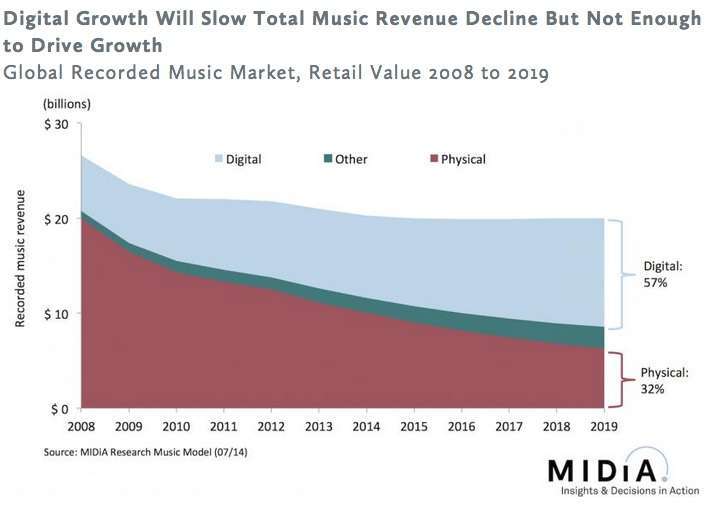
http://www.digitalmusicnews.com/wp-content/uploads/2014/07/salesplunge2019.jpg

                The rise of audio streaming platforms such as Spotify, Pandora, SoundCloud, YouTube, 8tracks, and a host of other sites makes the accessibility of music easier than anyone could ever imagine. With the  touch of a few keystrokes, anyone can have unlimited access to the many media streaming services from virtually anywhere: from your phone, computer, TV, car or any portable device. It is no wonder that the music industry is suffering. Major stars and artists speak out against the age of digital streaming. They scrutinize the corporations that make a handsome profit off their art that they spent all the money, hard work, blood, sweat and tears creating. Yet, these corporations do nothing to re-invest to keep the artists, that are making them so much money, afloat.

                Amanda Palmer, former lead singer of The Dresden Dolls and front runner of Amanda Palmer and the Grand Theft Orchestra, spoke at the 2013 Virgin’s Disruptors Conference. “…one weird thing is that iTunes, Apple Spotify, Google, whatever, all of the people who are profiting – [and] YouTube – who are profiting off the artists from the small level to the huge levels aren’t really feeding very much back into the creation of new content.  And, that’s actually one of the largest problems, and even though my views aren't nearly as extreme as David Byrne’s, he does bring up the giant question, which is ‘where is the capital going to come from to make art?‘… But wouldn't it seem that the place that is making the lion’s share of the profit should actually also be putting money back into the creation of content to make a healthy ecosystem?”
 
                High-profile bands like Pink Floyd have this to say: “Of course, this letter doesn’t say anything about an 85 percent artist pay cut. That would probably turn off most musicians who might consider signing on. All it says about royalties is ‘we are all fervent advocates for the fair treatment of artists. Fine print is one thing. But a musician could read this ‘letter of support’ a dozen times and hold it up to a funhouse mirror for good measure without realizing she was signing a call to cut her own royalties to pad Pandora’s bottom line.”
 
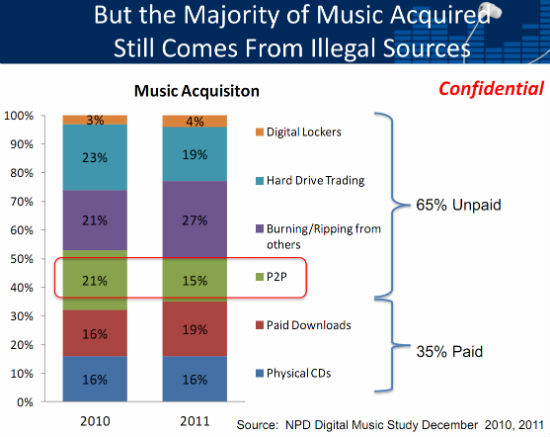
                Audio piracy is a cheap, fast way to get all your favorite music, and maybe to you a song or two here and there isn’t a big deal. I mean, Katy Perry and Justin Bieber are millionaires. They won’t miss the 99 cents from iTunes or the $17.99 it would be to buy a physical copy, right? Wrong. When everyone across the globe participates in audio piracy, the music industry takes a big hit. Since the emergence of Napster in 1999 and other peer-to-peer sites, American music sales have dropped a disturbing 53 percent from $15.6 billion to $7 billion. According to the Recording Industry Association of America (RIAA), “from 2004 though 2009 alone, approximately 30 billion songs were illegally downloaded on file-sharing networks…only 37 percent of music acquired by the U.S. consumers in 2009 was paid for.”

               Even headlining bands are noticing the dramatic decline of profit from albums. Iggy Pop states in his John Peel lecture at the radio festival, “If I had to depend on what I actually get from sales, I'd be tending bars between sets.” He goes on to talk about how the recent digital advances have caused the music industry to become “almost laughably pirate” and the electronic devices “estrange people form their morals and also make it easier to steal music than pay for it.”
 

http://torrentfreak.com/images/riaa-chart.jpg

               Not only does this merely affect CD sales, but the people who work for the music industry as well. Songwriters, recording artists, audio engineers, computer technicians, talent scouts and marketing specialists, producers, publishers and countless others (RIAA) take a great hit from profit losses. In fact a study, by the Institute for policy Innovation pinpoints the annual damage of audio piracy at $12.5 billion in losses to the United States economy, as well as $2 billion in wages, and a devastating 70,000 lost jobs.
 
               Born in the '90s, I was a kid exploring the beginnings of the Internet.  I discovered that I was in the height of LimeWire. I am ashamed to admit in my younger years (I’m only telling you this because I checked the statute of limitations, and I’m clear), I was an audio pirate. From the ages 7 to 14 I built my own corrupted empire; kids from all grades would give me list of songs to download for me to put on a disc for them. I would charge them $5 a CD. I distinctly remember just before my 10th birthday breaking my portable compact disc player and getting my very first iPod - I was instantly smitten. Yes, I had money from my criminal transactions, but it wasn’t enough to buy all the music I wanted. So what did I do? I just downloaded more songs. Sure, I knew it was a “crime”, but I didn’t really know how serious it was nor who or what I was affecting. Only until we had a talk in our Criminal Justice class and I conducted my own research did I realize I was part of the music industry’s problem.
 
                I seriously believe that if we teach kids at a younger age how their actions online can cause irreversible effects, then a lot of these problems will be solved. To my knowledge, there are no such programs available, but maybe this is something to consider installing in our future curriculum. Keep in mind, I’m not telling you to stop jamming out to Spotify or to boycott the iTunes store; they’re both amazing music platforms that I love using. I’m asking for you to stop and think next time you decide to rip a song off PirateBay—reflect on the repercussions of this action. When you digitally download an album, maybe every once and a while you can dish out the extra $10 to buy the physical copy. In the end, it will be worth it to see the music industry be restored to its former glory; there is no telling what we will see from it when it is.
 

http://web-profile.com.ua/wp-content/uploads/the-state-of-the-music-industry.png


Miata One Horse One Rider: The Ideal Sports Car Choice

                                                                   By: John SaupĂ©
            You open the door and sit down. You notice the seats hug your sides ever so slightly. You feel secure but not cramped. Then you put on the seat belt and turn the key. As you start to move, you notice the sensitive steering and tight handling. Now you hit the gas in first gear and it squeals the tires as you accelerate and feel the suspension tighten up. That’s when you love yourself for buying a Miata.
         

            Since its day view in the year 1989, the Mx-5 Miata has been the leader in the small roadster class. It is recognized worldwide as the inexpensive, reliable, and fuel-efficient track car made for the street. When the Miata came out, they sold like crazy because of this, which makes it the perfect car to start a race car project or a car to enjoy driving to work while getting 30 plus miles per gallon. This is great because now there are many parts available both aftermarket and original engine manufacture. So that brings us to the start of what this blog post is about.
 
            Over the years I have grown to love all sports cars for what they are. Sports cars have been around since people have manufactured cars. At first they were just stripped down versions of normal cars to increase speed and handling capability. But I am truly in love with the’ 90s sport cars. I have ridden in and worked on cars such as the Nissan 240sx, Toyota Supra, Corvette, and of course the Mazda Miata.

          When I went to go buy my first sports car, I made the mistake of getting a Honda Crx. Not a bad choice if you have a lot of money to make it reach its potential, but being a broke college student, I soon realized this and got rid of it for a 1994 Mazda Miata. I did my homework and sat down and figured out that it has almost everything I was looking for. The Miata is still just as slow as the Crx, but it has the potential, for less money, to become a true thrill to drive. What I was looking for was a reliable, two-door, lightweight, rear-wheel drive car. That was when it hit me. A 1990s Miata will run you about $3,000 for a nice one, or for my case, $1,800 fixer-upper. I was fine with this because, even though I am by all means not a car guru, I have the ability to do regular maintenance and small repair jobs such as oil changes and other random engine maintenance and repair requirements. Also, since the Mazda Miata was made in the 1990s, it is old enough to know the common problems and new enough to still easily find parts for the car.
 
          If you are looking for a reliable, fuel efficient, and fun drive, look no further. The Miata has been featured in many car magazines as well as on many forums as the number one track car even still today. It is the king today because of the previously mentioned attributes. And with the aftermarket for the car being massive with the help of companies such as Flyin Miata, anyone can build a street-legal race car. Companies such as Flyin Miata offer everything from oil filters, to wheels, to turbo, and suspension components. This is when what I call the cost to fun factor, comes in. For less than the price of a newer 2005 4.6 liter v8 Ford Mustang, you can have an older Miata that will eat the new 5.0 liter Mustang. Figure it this way; you buy a Miata for around $2,500 and build the engine for $2,000. Now you can make around 300 to 400 horsepower without blowing up the engine. Add another $3,500 in suspension and a turbo, and put a little elbow grease in there, and you have a monster! Oh yeah, and $8,000 is about what a mint condition 2005 Mustang should run you, unless you want the 2014 5.0, which starts at $31,210.
 
            One of the most commonly overlooked aspects of a race car is the weight. People love the Mustang as do I. But at the end of the day, it still weighs in close to 3,500 pounds when the Miata can be reduced to slightly under 2,000 pounds. This is where power to weight ratio comes out to bite the v8 owners in the butt. Let’s do the math; 300 horsepower on a low boost Miata that weighs 2,200 pounds is one horsepower for every 7.3 pounds. Now the new 5.0 Mustang weights around 3,700 pounds, which is not horrible by all means but does limit the ability of that car. Now the 3,700-pound Mustang makes 420 horsepower, which means the power-to-weight ratio is 8.8 pounds to the same one horsepower. Which, since you're reading this, you know that makes a huge difference especially on a back road. 

            This is why I encourage you, if you have not already bought one, to buy a Miata. The possibilities are endless for performance. Or if you want to keep it original and have fun do what you feel is right. Here’s a link to the Flyin Miata's website; http://www.flyinmiata.com/. So, go ahead and take a look at what’s there. If it’s for you, then chase your dreams. If it’s not, then have fun, but get ready to be passed! Thank you for reading have a great time on the streets!


                                                            Sources

Sunday, November 9, 2014

Chicago Here I Come!

  By Brandi Kornguth

Chicago Skyline Panorama View by Donald Scwhartz


             One of my favorite times to travel is in the fall. The weather is usually much more pleasant, and nature really starts to be a show-off. Have you ever been through the mountains after the leaves have begun turning? Talk about beautiful.  Last year, my adventurous spirit took me on a road trip to Charlotte, N.C., and Atlanta for a weekend with good friends and good times. Where am I headed this time? Looks like I’ll be headed up to Chicago for Halloween weekend to see some friends of mine play a show at The Bottom Lounge. This trip will be loaded with firsts for me, such as my first plane ride in many years, experiencing this venue for the first time, and finally getting a chance to stay in Downtown Chicago.
 
             This trip has been much more involved as far as planning than many other trips I’ve taken in the past. I plan to share some of my favorite and most handy trip planning tips and tricks I’ve picked up on the way. Here we go!
 
Where Am I Going?
 
            Getting to experience a new place or an old favorite is one of the most exciting parts of traveling. Obviously, knowing where you’re going is important, but so is knowing about where you plan on going. I suggest doing some research into the area you plan to visit, especially if you’re unfamiliar with it. You’ll want to know what attractions are popular in the area.
 
            For this trip, I’ll be heading to a part of Chicago I’m unfamiliar with.  I was directed to www.choosechicago.com, which is an incredibly informative site on all Chicago has to offer. One of the site’s most interesting features is that it offers an interactive map for neighborhood and area in Chicago. You’re better able to plan for your trip and find accommodations if you have a better understanding of what your surroundings will be.
 
How Am I Getting There
 
            Whether you plan to travel by plane or vehicle, how you plan to get to your destination is incredibly vital. Nowadays, we’re all looking for the best deal. Traveling can get quite pricey, but there are several ways to save a little money and hassle. For example, knowing the best days price-wise to purchase plane tickets can help save a lot upfront. Also, knowing how early to arrive at the airport before your flight takes off is very important in the planning process.
 
            I discovered the site http://www.cheapair.com/blog/travel-tips/top-10-tips-for-booking-cheap-flights/ to be a very informative on these subjects. I plan to fly for my upcoming trip and actually booked my flight through Southwest’s website. I got the best deals for my chosen travel days and times and the process of planning flights incredibly simple. Another great tip for those of you who are flying would be to check http://www.tsa.gov.traveler-information for information on what you can take on planes and answer any questions on the flight security process.
 
            For most of my trips, however, I tend more towards driving. You can actually use the gas calculator function on www.mapquest.com to see about how much your drive will cost you. Also, there’s really nothing like a road trip with friends. In that, it’s really more about the experience. Road trips are also great for sightseeing, and you can travel at your own pace. Depending on the duration of the trip, it would be wise to keep supplies with you. Important things may be food and beverages, chargers for electronic devices, books, and good music.
 
            Whichever means you use, making sure you’re getting the best bang for your buck and using the most convenient means of travel will make all the difference.
 
Where Am I Staying?
 
            Once you’ve figured out where you’re going and how you’re getting there, the next step is figuring out where you’re staying. Many useful sites like www.priceline.com and www.kayak.com can make the last two steps here a combined effort, and even help if renting a car is something you would need. First off, you need to know about the area you’re staying in as previously mentioned. Find out what’s going to be around you and what kind of area it is. I’ve used www.hotels.com for many of my lodging needs, but I’ve found that often times you find the best deals and room choices by booking directly through the hotel sites or parent company sites instead.
 
             For my trip to Chicago, I used www.hotels.com to narrow down the list of hotels I was interested in. I then went to each of the hotel’s sites to individually view and sift through each one. I found this method to really help me get what I needed at a reasonable price. Signing up for rewards programs at the hotels where you stay frequently can help you earn points towards things like free stays and promotions with local restaurants and businesses. I highly recommend this, especially if you plan to travel often.
 
            Looks like I’m all ready for my trip to Chicago, and now you know more about planning your own trips as well! Experiencing all the great things the world has to offer is what life is all about, and I hope this guide gets you started on your next adventure as well. Happy travels everyone!
           

Thursday, November 6, 2014

The Ryman Auditorium - Then and Now


By: Heather Cope


            The Ryman Auditorium is a huge staple in the history of Nashville. Many great artists, musicians, films, speeches and theatrical performances have been done on that historic stage. I have been blessed to attend several shows there and plan to attend many more in the future.
 
"The most amazing place I've ever sung in..."
-Vince Gill


            The auditorium was originally built to be a tabernacle. A tabernacle in the 1800s was a place of worship used by Protestants or Mormons. The auditorium was built by Captain Thomas Ryman at 116 Fifth Ave. N in downtown Nashville, Tenn. Thomas Ryman was a very successful business man and riverboat captain on the Cumberland River. Ryman became very wealthy and established with his 35 riverboats and multiple saloons in the area.

What would inspire a man to build a place of worship when his primary livelihood was drinking and gambling? Ryman and his friends attended a sermon preached by a reverend by the name of Sam Jones. They initially attended to stir up a riot and protest his preachings. Instead, it changed Thomas Ryman's life, and steered him in a whole new direction. It has been said that after that sermon, he dumped every bottle of whiskey aboard his riverboats into the river and never had another drink again. After seven years and an investment of $100,000, the tabernacle was finished in 1892. It opened its doors as Union Gospel Tabernacle. There, Sam Jones preached his sermons for many, many years.
 

            Thomas Ryman passed away on Christmas Day in 1904. He was 63 years old. The Rev. Sam Jones then changed the name of the establishment to the Ryman Auditorium in his memory. Income for the auditorium began to decline. The manager in the early 1900s was a woman named Lula C Naff. She worked extremely hard to keep the Ryman relevant by selling tickets on the streets of Nashville to various shows such as Bob Hope, Roy Rogers, and Katherine Hepburn. Unfortunately, the doors closed, and there was even talk of demolition.


The Grande Ole Opry saved the auditorium by occupying it from 1943 to 1974. The Grand Ole Opry was a broadcast of country music performances on WSM-AM. Here, there were many magical and historical performances by artists including Johnny Cash, Elvis Presley, Charlie Chaplin, Hank Williams, Patsy Cline, and even Harry Houdini. President Theodore Roosevelt even graced the stage of the Ryman. Popular movies such as “The Coalminers Daughter” were filmed there. Also, Johnny Cash's show aired there from 1969 until 1971. Because of all the amazing artists and performances, the Ryman became known as "the Carnegie Hall of the South".

            The Grand Ole Opry eventually moved to the Opryland Theme Park, and the Ryman Auditorium was once again vacant and without funds. In 1994, Ed Gaylord purchased Opryland and the surrounding areas, as well as the Ryman. He funded an $8.5 million renovation on the Ryman. Even though it moved to a new location, the Grand Ole Opry still holds special performances there every year during the holiday season since 1999.

Since it was remodeled, even more performances have made history on that stage. The Ryman has been named one of the nations best venues, as well as voted "Theatre of the Year" from 2010 - 2013. Almost all music genres are welcome there, including gospel, jazz, blues, or alternative rock. Even television shows like “American Idol” have been filmed there. Many more current artists have performed there, such as Zac Brown Band, ZZ Top, and Elvis Costello.
 
"The greatest theatre in the world!"
-Coldplay


            I have had the pleasure of attending several shows within the walls of the Ryman Auditorium. I have enjoyed every single one, and I plan on attending as many as I possibly can in the future. There is not a bad seat in the house, and the acoustics are ideal! The first artist that I saw at there was Jack Johnson. Jack is a Grammy-winning singer and songwriter from Oahu, Hawaii. He sings and plays folk rock, surf, and acoustic music. He is one of my all time favorite artists.

            Another artist I was lucky enough to see there is Jason Mraz. He is also a Grammy-winning singer and songwriter from Virginia and San Francisco. His genre of music is pop, smooth jazz, and soul.

            Attending live shows is my favorite hobby. I collect memories and experiences. The amount of talent that I witness attending shows, not only at the Ryman but also at other music venues in the Nashville area, is amazing to me. I will always have an ever-growing passion and great appreciation for music and the history behind it.

            If you are interested in learning more about Captain Thomas Ryman, you can make a trip to The Palace Theatre in Gallatin, Tenn. They are presenting a musical rendition of his life called “The Ryman Diaries”. This play is written by a local author Debbie Mathis Watts in collaboration with noted actor Tom Doland. The performance is an old-fashioned romantic comedy-drama that is suitable for all ages. Show times vary during the fall months. Tickets are $10. Once the Gallatin premier of the show has ended, it will later run in other locations, including Nashville.

If you are interested in learning more about the Ryman itself, the venue offers self-guided and backstage tours. These tours are held daily between 9 a.m. – 4 p.m. The price for Adult admission ranges from $15 to $20. Child admission ranges from $10 to $15.


Contact Information:

Ryman Auditorium

615.889.3060
116 5th Ave North
Nashville, TN 37219

Ticketing: (615) 889-3060
Administration: (615) 458-8700

Box Office Hours
9 a.m. to 4 p.m. Seven days a week

The Palace Theatre

(615) 230-0884

146 North Water Avenue

Gallatin, TN 37066


Sources:


Wednesday, November 5, 2014

College Study Groups Help Students Succeed


By Katherine Ferrer
     Beginning a new school year is always somewhat intimidating yet exciting. However, after the first test or even after the first quiz, students begin to lose motivation in their studies. A study done by CBE Life Science Education found that almost 14 percent of students always use study groups, while 55 percent of students have never used a study group. These numbers show that students are willing to learn through study groups, yet they may be too shy or too busy to become involved in one.

     Tips from The Huffington Post have found that study groups help students divide and conquer work and reduce their workload. A study from Montclair has found that study groups not only avoid procrastination, but they also help students understand the information more effectively and develop new study skills. These few ways of being involved in a study group can tremendously benefit a student who is not doing so well in a class or who just needs more confidence in his or her studies.

     Starting a study group can be very intimidating, but after stepping up and asking others to be in a study group with you, it will pay off quickly. One way to begin a study group is to pick willing participants. After you establish your study group, the next step is to exchange methods of communication with the other people in your group. Finally, to get your group started, you will need to establish a location to study. These few steps not only help students become acquainted with other students, but it helps to begin the semester with studying and learning the material better and easier.

     From personal experience, I have found that forming study groups helps others gain different perspectives, and they also help students make new friends. One advantage to being in a study group is that it ensures you are learning the correct material, and if you and your colleagues stumble upon an unanswered question, you will know that you are not the only one who is facing it. Furthermore, it helps students manage their time, either personally or professionally. Being in a study group is not necessarily a goal to compete, but it does give students some incentive to do better than the other students in their group.


     In all, study groups help keep students focused in their studies. Being involved in a study group helps students learn and understand the material more effectively. With no question, students who are not involved in a study group should be because it will only help better their educational skills, and it will help them gain confidence in fields that they did not even think would help them.